Human Aminopeptidase N ELISA [ANPEP]: A Comprehensive Overview
The Human Aminopeptidase N (ANPEP) ELISA is a critical tool for detecting and quantifying ANPEP in biological samples such as serum, plasma, and tissue homogenates. ANPEP, also known as CD13, is a type II transmembrane protein involved in various physiological and pathological processes, including immune response, angiogenesis, and tumor progression. This enzyme is a key biomarker in cancer, inflammatory conditions, and infectious diseases.

Key Features of the ANPEP ELISA Kit
- High Sensitivity and Specificity: The kit accurately measures low concentrations of ANPEP, ensuring precise quantification.
- Wide Application: Applicable to various sample types, making it versatile for research and clinical diagnostics.
- Reproducible Results: Rigorous validation ensures consistency across experiments.
- User-Friendly Protocol: Simplified steps for efficient processing without compromising accuracy.
Biological Significance of ANPEP
ANPEP is expressed on the surface of many cell types, including epithelial cells, endothelial cells, and certain immune cells. It plays a critical role in:
- Protein Metabolism: By catalyzing the removal of N-terminal amino acids from peptides (NCBI Bookshelf).
- Angiogenesis: Promoting blood vessel formation, a process essential for wound healing and tumor growth (NIH Research).
- Immune Function: Regulating leukocyte trafficking and cytokine release (PubMed).
- Infectious Disease Research: Serving as a receptor for viruses like the human coronavirus (CDC Coronavirus Information).
Learn more about ANPEP’s biological significance on trusted platforms such as NCBI and NIH.

ANPEP in Disease Research
The overexpression or dysregulation of ANPEP has been implicated in several diseases, making it a valuable biomarker for:
- Cancer: Elevated ANPEP levels are associated with tumor progression, metastasis, and poor prognosis in cancers like colorectal, lung, and breast cancers (National Cancer Institute).
- Inflammatory Disorders: Its role in cytokine modulation links it to conditions like rheumatoid arthritis and inflammatory bowel disease (NIH Arthritis Research).
- Infectious Diseases: ANPEP acts as a receptor for pathogens, contributing to viral and bacterial infections (CDC Infectious Disease Data).
Explore detailed studies on ANPEP in disease mechanisms on PubMed and CDC.
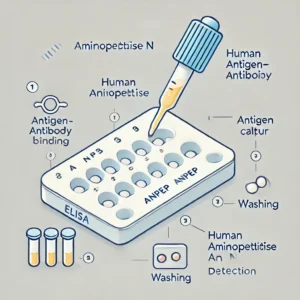
Workflow of the ANPEP ELISA
- Sample Preparation: Guidelines are provided for preparing serum, plasma, or tissue lysates to optimize ANPEP recovery.
- Antigen Capture: Specific antibodies immobilized on a plate bind to ANPEP molecules in the sample.
- Signal Amplification: Enzyme-linked secondary antibodies generate a detectable signal.
- Quantification: Absorbance readings at a specific wavelength provide accurate measurements.
Detailed protocols can be accessed via resources such as the FDA Research Tools and CDC Laboratory Practices.
Applications of the ANPEP ELISA
- Oncology Research: Investigating ANPEP’s role in tumor angiogenesis and metastasis (Cancer Research Highlights at NIH).
- Immunology Studies: Exploring its function in immune cell activation and migration (NIAID Immunology Resources).
- Virology Research: Examining ANPEP as a receptor for coronaviruses and its role in viral entry (NIH Coronavirus Research).
- Drug Development: Evaluating the efficacy of ANPEP-targeted therapies (FDA Clinical Trials Database).
Why Choose the Human ANPEP ELISA?
The Human ANPEP ELISA kit provides reliable and reproducible results, making it a trusted choice for researchers and clinicians. It facilitates the study of ANPEP’s diverse functions and its implications in health and disease.
For additional information, consult the following resources:
- National Institutes of Health (NIH)
- National Center for Biotechnology Information (NCBI)
- Centers for Disease Control and Prevention (CDC)
- Food and Drug Administration (FDA)
- National Cancer Institute (NCI)
By leveraging this advanced ELISA, researchers can deepen their understanding of ANPEP’s role in disease mechanisms and accelerate the development of innovative treatments.

You May Also Like

Biomedical articles share annotations with their citation neighbors
March 4, 2021
Robust Data Integration Method for Classification of Biomedical Data
May 4, 2021