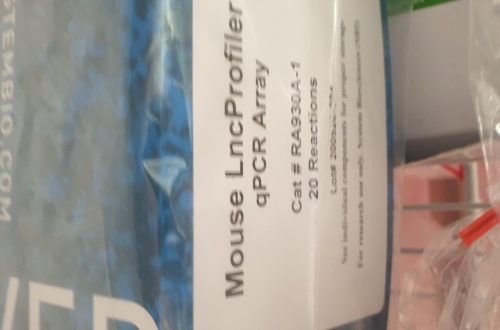
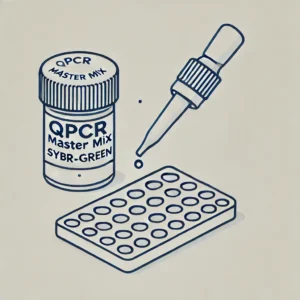
qPCR Master Mix (SYBR-Green) is a widely used reagent for real-time quantitative PCR (qPCR), enabling accurate quantification of nucleic acids. This versatile mix is pre-optimized for efficiency and specificity, making it indispensable in molecular biology, diagnostics, and research applications.
- Pre-Formulated Convenience
The qPCR Master Mix combines key components such as DNA polymerase, dNTPs, SYBR-Green dye, and optimized buffer systems. This simplifies the experimental setup, as highlighted by the National Center for Biotechnology Information (NCBI).
- High Sensitivity and Specificity
The SYBR-Green dye binds specifically to double-stranded DNA, ensuring sensitive detection of amplification products. Learn more about the mechanism in resources from the National Institutes of Health (NIH).
- Wide Dynamic Range
The qPCR Master Mix can detect a broad range of target concentrations, as validated in protocols from the Centers for Disease Control and Prevention (CDC).
- Compatibility
It is compatible with most qPCR platforms, as recommended by the U.S. Food and Drug Administration (FDA) for clinical research applications.
- Gene Expression Analysis
qPCR is extensively used to study gene expression patterns. Resources from Stanford University and Harvard University provide insights into using SYBR-Green for quantifying mRNA levels.
- Pathogen Detection
Public health laboratories, like those guided by the World Health Organization (WHO), use qPCR Master Mix to detect pathogens such as viruses and bacteria.
- Genotyping and Mutation Analysis
Research supported by the National Cancer Institute (NCI) shows how qPCR Master Mix aids in SNP genotyping and mutation screening.
- Environmental DNA Studies
The Environmental Protection Agency (EPA) employs qPCR methods to monitor microbial populations in water and soil samples.
How qPCR Master Mix (SYBR-Green) Works
- Binding Mechanism: SYBR-Green binds to double-stranded DNA during the amplification process, emitting fluorescence proportional to the quantity of DNA present. The fluorescence data is analyzed in real time. Detailed mechanisms are described in PubMed articles.
- Amplification: The mix includes a thermostable DNA polymerase, ensuring robust and reproducible amplification cycles, as recommended by the NIH Genomics Research Center.
- Quantification: By comparing fluorescence signals to a standard curve, researchers can quantify nucleic acids with high precision, as emphasized by the University of California, Berkeley.
Regulatory Compliance and Standards
The use of qPCR Master Mix (SYBR-Green) complies with global quality standards:
While probe-based qPCR systems like TaqMan offer additional specificity, SYBR-Green qPCR Master Mix is cost-effective and versatile. Studies at Johns Hopkins University highlight its utility in large-scale projects where cost considerations are critical.
Conclusion
qPCR Master Mix (SYBR-Green) is a cornerstone of modern molecular biology and diagnostic research. Its simplicity, sensitivity, and compatibility with a wide range of applications make it indispensable for laboratories worldwide. For detailed protocols and best practices, refer to resources from the NIH, CDC, and FDA.